

The European spa sector is not a monolith. Spread across more than two dozen countries, it encompasses centuries-old thermal traditions, regionally distinct mineral water compositions, and regulatory environments that vary enormously from one border to the next. Operators and associations working across this landscape face a common challenge: fragmentation. Without a shared European voice, individual national associations negotiate policy in isolation, miss scientific collaboration opportunities, and struggle to position health tourism as a credible preventive health practice.
Collective representation changes that equation. When spa and health resort operators align under a European umbrella, they gain access to EU-level policy dialogue, structured knowledge exchange, and the scientific credibility that comes from sustained research collaboration. They gain a seat at the table when regulatory frameworks affecting natural healing resources are being written. That matters enormously for the long-term health of the sector.
We are ESPA EHV, the European umbrella organization of spa and health resort associations across Europe. We advance balneology, natural healing resources, and sustainable wellness practices and advocate, collaborate, and facilitate expertise among members. The European Spas Association has been building this network since 2003, and the value it creates for members goes well beyond a shared listing or a directory entry.
What Does ESPA Spa Mean?
ESPA EHV stands for the European Spas Association, known in German as the Europäischer Heilbäder-Verband. It is a European umbrella organization representing national and regional spa associations and health resort operators, with a mandate focused on balneology, natural healing resources, and sustainable wellness tourism policy. It is not a consumer-facing spa brand.
Balneology itself is the scientific discipline concerned with the therapeutic application of mineral and thermal waters, peloids, and related natural resources. It sits at the intersection of medicine, geology, and environmental science. Our work at ESPA EHV draws on this discipline directly: we partner with institutions like the Fresenius Group for mineral water analysis and support research that keeps natural healing practices grounded in evidence rather than anecdote. It is through the intertwining of healthcare, tourism, research, and policy that we will be able to make sure that natural remedies using mineral water, climate, and landscape will not be lost and will continue to be credible and future-ready.
How Many European Countries Are Represented in Professional Spa Networks?
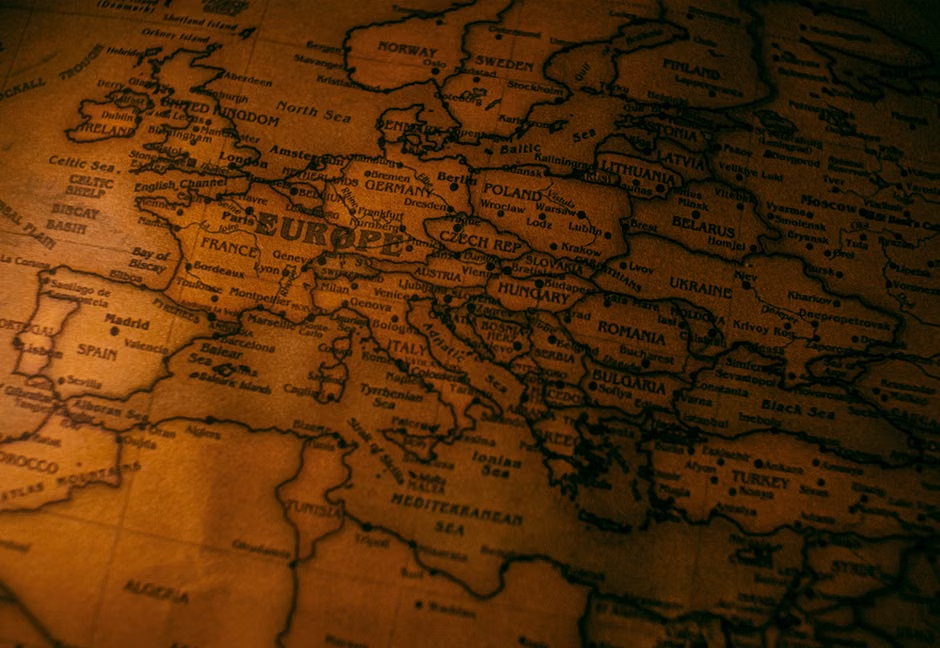
Europe contains 44 countries by most political definitions, with the European Union comprising 27 member states. ESPA EHV draws membership from across this geography, with active member organizations in Czechia, Hungary, Iceland, Germany, Austria, Slovenia, Romania, Italy, Spain, Turkey, Greece, and the Baltic region, among others. That breadth is not a vanity metric. It is a practical asset: pan-European representation means that when we engage with EU institutions or European tourism bodies, we speak with the collective authority of an entire continent’s professional sector.
Understanding how many European countries are engaged in a network like ours also clarifies the regulatory complexity members face. A health resort in Romania operates under different certification frameworks than one in Germany. A mineral water spa in Iceland navigates entirely different tourism policy environments than one in Italy. Our role is to provide the connective tissue, the shared standards and common advocacy, that allows operators across all these contexts to function as a coherent European sector rather than isolated national niches.
The Congress of ESPA, held since 2003, is one of the primary forums where this cross-border collaboration becomes concrete. Scientific presentations, policy discussions, and professional networking all happen under one roof, connecting representatives from across European countries who would otherwise rarely share a room.
What Are the Benefits of European Spas?
European health resorts built around natural thermal and mineral resources offer documented therapeutic and preventive health benefits. The evidence base for balneological treatments has grown substantially over the past two decades, and our member organizations have been active participants in building and disseminating that knowledge.
“Balneotherapy, defined as the use of bathing in natural mineral or thermal waters for therapeutic purposes, has demonstrated clinical benefits for musculoskeletal conditions, chronic pain, and skin disorders across multiple peer-reviewed studies.”
For member organizations affiliated with ESPA EHV, the benefits of belonging to a European network mirror the health benefits their facilities deliver: cumulative, evidence-based, and more powerful when engaged consistently over time. Membership creates access to:
- EU-level policy advocacy that protects natural healing resources and spa heritage designations
- Scientific collaboration and research networks in balneology and hydrotherapy
- Shared certification and quality standards that strengthen credibility with insurers and health tourism planners
- Cross-border marketing and tourism positioning through pan-European campaigns
- Knowledge exchange on sustainable operations, mineral water analysis, and peloid therapy
- Representation in EU policy dialogues affecting the health tourism sector
Is ESPA a Luxury Spa Brand?
No. ESPA EHV is a professional advocacy organization, not a consumer-facing brand. There is a separate skincare and spa product company that uses the ESPA name in the consumer wellness market. The two are entirely unrelated. Our membership is institutional: national spa associations, regional health resort federations, and professional operators.
This distinction shapes what membership actually delivers. We don’t provide retail products, individual consumer memberships, or branded consumer experiences. What we provide is collective representation through a single European umbrella, scientific credibility through documented research partnerships, and policy access built over two decades of sustained engagement with EU institutions. For operators who need political and scientific standing rather than a consumer brand affiliation, that is the more durable asset.
Who Is ESPA EHV Membership Right For, and Who Should Look Elsewhere?
Membership in ESPA EHV makes the most sense for national and regional spa associations seeking a collective voice at the European level, health resort operators with a genuine connection to natural healing resources (thermal springs, mineral waters, peloids, therapeutic landscapes), and organizations already engaged in quality certification programs or aspiring to build that credibility.
It isn’t the right fit for every wellness business. Day spas without a connection to natural healing resources, hospitality operators whose wellness offering is primarily amenity-driven, or organizations with no interest in policy engagement will find limited alignment with our mandate. We are honest about that. The value of membership compounds for those actively working to position natural remedies using mineral water, climate, and landscape as credible therapeutic tools, not as consumer luxuries. If that is your organization’s mission, the network we’ve built across European countries is directly relevant to your work.
For organizations at the boundary, the best first step is a conversation with the Executive Board to assess strategic fit before committing to membership. Joining a network that doesn’t align with your operational reality won’t serve either party well.
What Are Red Flags to Avoid When Evaluating Spa Associations?
Not all professional associations deliver equivalent value. When evaluating any European spa network, certain warning signs suggest the organization may struggle to make good on its membership promises.
- No published standards or certification programs: associations without quality benchmarks offer little more than a listing
- No documented policy engagement history: claims of EU-level access should be verifiable through published proceedings, formal advisory roles, or named institutional partnerships
- Opaque governance structures: member-governed organizations should have transparent board processes and clear accountability
- No scientific or research partnerships: credible balneology advocacy requires genuine connections to the scientific community
- Vague benefit descriptions: “networking opportunities” without specifics signals that the association hasn’t built concrete member value
ESPA EHV’s governance, research partnerships, policy record, and certification programs are publicly documented. Our institutional history, active since 2003, is part of our credibility. The ESPA EHV home page outlines the organization’s structure and mandate transparently for prospective members and partner institutions alike.
“Traditional and complementary medicine is an important and often underestimated part of health care. It is found in almost every country in the world, and the demand for its services is increasing.”
— World Health Organization, Traditional and Complementary Medicine
What to Expect After Joining, and When
Membership in a European umbrella organization isn’t a quick fix. The most tangible near-term benefits arrive within the first year: access to the member network for knowledge exchange, inclusion in European-level advocacy communications, and eligibility for certification and standards programs. Longer-term benefits, particularly policy influence and scientific collaboration, compound over time as your organization builds relationships within the network and contributes to shared initiatives.
As contributing writer Richard Hargreaves has observed across multiple European spa markets, the organizations that extract the most value from membership are those that show up consistently. Attending the Congress, contributing to working groups, and actively sharing knowledge rather than passively receiving it. The network is as strong as the participation of its members.
A realistic timeline looks something like this. In the first six months, your team connects with counterparts in other European countries, gains access to shared research and standards documentation, and begins the certification process if applicable. By year two, your organization has contributed to and benefited from at least one cross-border initiative. Over five years, you have standing within a professional community that speaks with genuine authority on the future of health tourism, balneology, and natural healing resource preservation across the continent. As balneotherapy’s documented history demonstrates, this knowledge tradition predates modern pharmaceutical medicine by millennia. It deserves the kind of institutional protection that only collective European representation can provide.
The spa and health resort traditions of Europe are worth protecting as a sector, not just as individual businesses. Joining ESPA EHV is a decision to contribute to that protection collectively rather than navigate the landscape alone. The question isn’t whether European health tourism needs a unified voice. It does. The question is whether your organization wants to help shape what that voice says next.